Federal Scholarship Tax Credit
A new federal scholarship tax credit program lets employees direct a portion of their paycheck to K-12 scholarships through a certified scholarship granting organization (SGO) — and get up to $1,700 back at tax time.

What is the Federal Scholarship Tax Credit (FSTC)?
Starting Jan. 1, 2027, in states that choose to participate, individuals can donate to a certified SGO and receive that same amount back as a dollar-for-dollar federal tax credit — up to $1,700 per taxpayer, per year ($3,400 for married couples filing jointly). This program is also known as the Education Freedom Tax Credit (EFTC) and was enacted into law as the Educational Choice for Children Act (ECCA). BenefitEd’s platform makes giving as simple as offering a payroll election option to your employees that lets them take advantage of this tax credit.

How the Tax Credit Works for Employees
Employee Identifies an SGO to Support
Employees choose a Scholarship Granting Organization (SGO) to support — often based on its mission or community, since by law every SGO funds students across multiple schools. The SGO must be listed by a state that has opted in to the FSTC. If an employee’s own state hasn’t opted in yet, they can still donate to a qualifying SGO in a state that has.
Sets Up a Payroll Deduction
Employees log in to the company's BenefitEd portal, where they choose an SGO and school they'd like to support, along with their annual contribution amount. That amount spreads automatically across each paycheck based on the employer's payroll cycle. Employees can also adjust their W-4 withholding — BenefitEd coordinates with their employer — to help offset the paycheck impact.
BenefitEd Securely Transfers Funds
BenefitEd's platform connects securely with your HR and payroll systems through an encrypted file transfer or API connection to process each employee's payroll deduction and route funds to their selected SGO. Every transaction is tracked, giving your HR team a clear reporting and audit trail.
SGO Awards the Scholarship
The SGO reviews applications and awards scholarships to eligible students. Federal rules require priority go first to students continuing a scholarship from the year before, then their siblings — protecting continuity for families already relying on the program. Beyond that, the SGO awards remaining scholarships to newly eligible students as funding allows.
Employee Files Taxes
Employees receive a receipt from their SGO documenting their total contribution for the year, which they use when filing taxes. They can then claim a dollar-for-dollar federal credit for what they donated, up to $1,700 — reducing what they owe. If the credit is more than they owe, the unused portion carries forward for up to five years.
Because every contribution flows through an SGO, it helps to understand exactly what one is and what it’s required to do.
The SGO’s Role in Administering the FSTC

An SGO is the certified nonprofit at the center of the program, collecting contributions and awarding scholarships to eligible K-12 students. By law, an SGO must serve students across more than one school and can’t earmark funds for a specific student — though some allow donors to recommend a specific school. SGOs must direct at least 90% of contributions to student scholarships, capping their own administrative costs at 10%.
SGOs can support private faith-based schools, public schools, and charter schools. Home school and hybrid learning students may also qualify, though eligibility depends on whether their state legally defines homeschooling as a school — not all states do.
How FSTC Scholarship Funds Support Students
Once an SGO awards a scholarship, funds go to the eligible family — not the school directly — to cover qualified K-12 expenses, including:
- Tuition and fees.
- Tutoring.
- Books and supplies.
- Technology and internet access.
- Special needs services.
- Room and board, uniforms, and transportation.
- Extended day programs, where the school requires or provides them.

Both public and private school students can qualify, though funds are typically used differently:
- Private school families often apply scholarship funds toward tuition.
- Public school families, who don’t pay tuition, can instead use funds for services their school may not otherwise cover — tutoring, before- and after-school care, or additional support for a student with special needs.
Once a scholarship is awarded, how it’s used is between the SGO and the family — BenefitEd’s role ends at making the contribution itself simple.
How Organizations Benefit
Whether you’re a company, nonprofit, or educational institution, offering this benefit to employees looks a little different.


Key Federal Scholarship Tax Credit Facts

Credit Value
Up to $1,700 per taxpayer, per year ($3,400 for married couples filing jointly) — dollar-for-dollar, nonrefundable.
Effective Date
Contributions made on or after Jan. 1, 2027.
Eligibility for a Scholarship Tax Credit
Household income at or below 300% of the area median gross income.
SGO Spending Rule
At least 90% of contributions go directly to scholarships.
State Availability
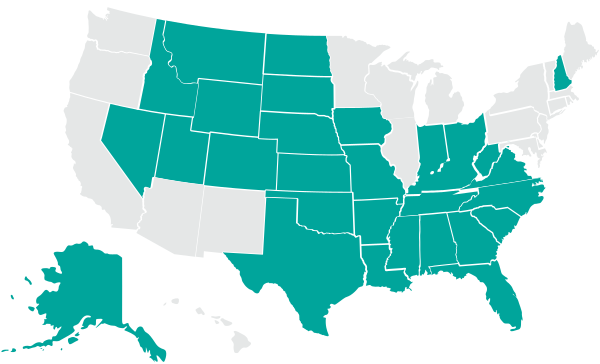
Any taxpayer can claim this credit, regardless of where they live. What varies by state is which SGOs, and the students they support, are eligible: each state must opt in annually before its SGOs can accept credit-eligible contributions.
Frequently Asked Questions
Have Questions About the Federal Scholarship Tax Credit?
This BenefitEd option is new, and the details can be a lot to take in. Our team can walk you through how it works and what it could mean for your organization or your community.
Disclaimer: This page is for general informational purposes only and does not constitute tax, legal, or financial advice. Tax laws and regulations are subject to change, and individual circumstances vary. Consult a qualified tax advisor or financial professional regarding your specific situation.